
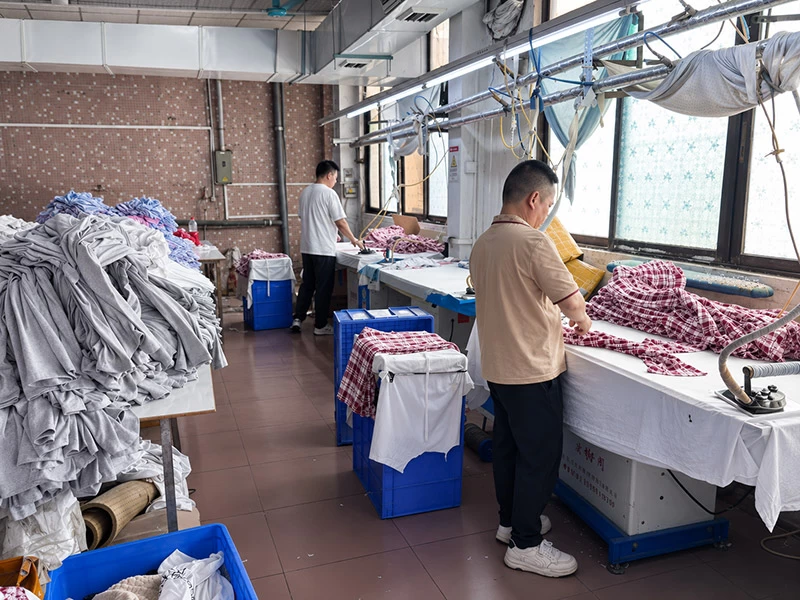
Fabric selection is the decision that shapes an apparel programme more than any other. It determines how a garment feels on the shelf, how it survives the first wash, what it costs to produce, and whether a buyer earns a repeat order. For brands sourcing women's wear, loungewear, kidswear or knitted apparel, understanding how a manufacturing partner evaluates and combines fabrics turns an opaque process into a manageable one — and it starts long before the first sample is cut.
In This Guide
- How Fabric Choice Drives Cost, Comfort and Compliance
- The Main Fabric Families for Apparel Programmes
- Fibre Content and Blends: What Each Choice Buys You
- Specifications to Confirm Before Sampling
- Colour Approval and Fastness Testing
- Fabric Inspection: The First Quality Gate
- Frequently Asked Questions
- Select Materials With a Manufacturing Partner
How Fabric Choice Drives Cost, Comfort and Compliance
Every fabric decision carries three consequences at once. Fibre content sets the price floor and the hand feel. Construction — woven, single knit, rib, terry or interlock — sets the stretch, drape and durability. Finishing treatments set the colour performance and the special properties, such as moisture management or softness. Change one and the other two move with it.
This is why the most productive first conversation with a manufacturer is not about price per piece, but about end use: which market the garment is sold in, how consumers will wash it, and what the garment must do that a cheaper alternative cannot. Dongguan Caiyun Clothing opens every project at exactly this point, confirming product references, target market, sizes, quantities, materials, colours, labels and packaging requirements before any technical work starts.
The Main Fabric Families for Apparel Programmes
| Fabric Family | Typical Composition | Best Suited To | Watch Out For |
|---|---|---|---|
| Cotton jersey | 100% cotton or cotton/elastane | Tops, camisoles, casual sets | Shrinkage — confirm tested allowance |
| Rib knit | Cotton/elastane, viscose blends | Fitted tops, trims, cuffs | Narrow usable width raises consumption |
| French terry & fleece | Cotton or cotton/polyester | Hoodies, sweatshirts, sweatpants | Pilling on low-quality yarn |
| Satin & woven blends | Polyester satin, viscose | Sleepwear, button-front pyjama sets | Snagging, seam slippage |
| Ribbed knit with stretch | Viscose/nylon/elastane | Lounge sets, layering pieces | Recovery loss if elastane content is low |
Fibre Content and Blends: What Each Choice Buys You
- 100% cotton — breathable and skin-friendly, the default for kidswear and sleepwear where parents read the label. Costs more and shrinks more than blends.
- Cotton/elastane — adds recovery and shape retention with a small percentage of elastane, usually 3–8 percent. The workhorse for fitted tops and lounge sets.
- Viscose and modal — exceptional drape and a cool, silky hand feel. Popular in loungewear; requires careful handling because it loses strength when wet.
- Polyester blends — colour retention, wrinkle resistance and lower cost. Well suited to satin sleepwear and to programmes where easy care outranks natural feel.
There is no universally correct answer. A pyjama set for a warm market may perform best in lightweight cotton, while the same silhouette for a cool market may sell better in brushed viscose blend. Matching fibre to market expectation is what converts a technically acceptable garment into a commercially successful one.
Specifications to Confirm Before Sampling
Five specifications should be locked in writing before a sample is made. They form the basis of both the approved sample and the bulk production order.
| Specification | Why It Must Be Fixed Early |
|---|---|
| Fibre composition | Drives hand feel, care labelling and customs classification |
| Weight (GSM) | The clearest single indicator of quality for the price quoted |
| Width | Determines fabric consumption, and therefore unit cost |
| Colour reference | Lab-dip approval prevents shade disputes at bulk stage |
| Shrinkage allowance | Built into the pattern before cutting, not corrected afterwards |
Colour Approval and Fastness Testing
Colour is the most common source of dispute in apparel sourcing, and almost all of it is preventable. The sequence that works is straightforward:
- Submit the target colour as a physical swatch or a defined colour reference.
- Receive and review a lab dip before bulk fabric is dyed.
- Approve the dip, or request a corrected submission, in writing.
- Confirm fastness results for washing, rubbing and perspiration before shipment.
For programmes sold into the United States, the United Kingdom, Germany, Australia, Japan, the Middle East and Southeast Asia, this sequence also produces the documentation buyers need for customs clearance inspection. Caiyun Clothing provides a detailed packing list showing style, size and colour quantities before shipment, together with available compliance test documents.
Fabric Inspection: The First Quality Gate
Quality control in garment manufacturing begins before the first stitch. Incoming fabric inspection checks for shade variation between rolls, width deviation, weaving or knitting defects, and contamination. Catching these at goods-in protects the whole order: a shade band discovered in fabric costs a roll, while the same band discovered in finished garments costs every piece cut from that roll.
Dongguan Caiyun Clothing combines this incoming check with semi-finished patrol inspections during sewing, full finished-garment inspection, and a pre-shipment review, so that fabric defects and construction faults are separated and addressed at the stage where they can still be economically corrected.
Frequently Asked Questions
Can I supply my own fabric to the manufacturer?
Buyer-supplied fabric is workable when specifications are documented, but it shifts shrinkage and defect risk to the buyer and complicates lead times. For most programmes, sourcing through the manufacturer is faster and carries clearer responsibility for consistency.
How do I compare two fabric quotations fairly?
Compare fibre composition, GSM, usable width and tested shrinkage side by side. A quotation missing any of these four figures cannot be compared on price, because the difference may be entirely in specification.
What MOQ applies to custom fabrics?
Low MOQ is available for in-stock platform styles and fabrics. Custom original new styles carry a moderate minimum quantity, which supports test orders for new sellers as well as bulk restocking for established brands.
How quickly can a sample be developed in a new fabric?
Standard sample development normally takes approximately 3–7 days. If a new fabric must be sourced and dyed first, that stage is planned and quoted separately so the sampling date stays realistic.
Related Reading
- Knitted Apparel: Construction, Fabrics and Quality Explained
- Apparel Size and Fit Specifications for Bulk Orders
- About Dongguan Caiyun Clothing Co., Ltd.
- Frequently Asked Questions
Select Materials With a Manufacturing Partner
Dongguan Caiyun Clothing Co., Ltd. is an integrated apparel enterprise covering design, sampling, cutting, sewing, finishing, inspection, private-label customisation and one-stop global export support. From our base in Chashan Town, Dongguan, we work with international brands, wholesalers and cross-border sellers on women's fashion, loungewear and sleepwear, kidswear and knitted apparel.
Share your reference styles, target market, sizes, quantities and material preferences, and our team will confirm a specification and prepare a quotation for your review.
