
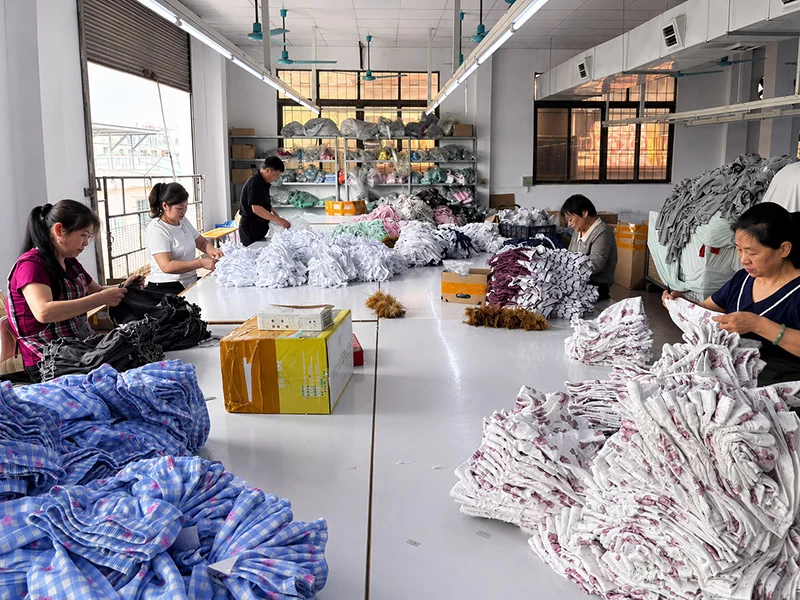
Knitted apparel has become one of the fastest-growing categories in global fashion retail. Its stretch, softness and year-round comfort make it a natural fit for women's wear, loungewear, kidswear and casual sets — the four product lines that Dongguan Caiyun Clothing Co., Ltd. manufactures every day. Yet buyers frequently discover that two suppliers quoting the same knitted style can deliver very different results, because "knit" describes a construction method rather than a single fabric. Understanding the variables behind knitted garments helps brands brief their manufacturing partner accurately, control cost and avoid costly rework.
In This Guide
- What "Knitted" Actually Means
- The Four Knit Constructions Buyers Should Know
- Yarn Count, Weight and Why Grams Per Square Metre Matters
- Shrinkage, Colour Fastness and Stretch Recovery
- Customisation Options That Work Well on Knits
- Quality Checkpoints for Knitted Apparel
- Frequently Asked Questions
- Work With a Knitted Apparel Manufacturer
What "Knitted" Actually Means
Woven fabric is built from two sets of yarns crossing at right angles. Knitted fabric is built from interlocking loops. That single structural difference explains almost every performance characteristic buyers care about:
- Stretch and recovery — loops move with the body, so knitted garments stretch without elastane and return to shape after wear.
- Drape and softness — the loop structure is bulkier and softer against the skin, which is why loungewear and sleepwear rely on it.
- Breathability — air passes between loops, supporting comfort in warm climates and layering in cool ones.
- Lower seam strength than woven — knits can unravel if cut edges are not finished correctly, so construction detail matters more, not less.
The Four Knit Constructions Buyers Should Know
Most apparel programmes draw on four families. Each behaves differently in production, and each carries a different cost profile.
| Construction | Typical Use | Key Characteristics | Cost Level |
|---|---|---|---|
| Single jersey | T-shirts, camisoles, lightweight tops | Thin, smooth face, limited stretch, prints well | Low |
| Rib knit | Tank tops, trims, cuffs, fitted bodies | High vertical stretch, excellent recovery, narrow width | Low–medium |
| French terry / fleece | Sweatshirts, hoodies, wide-leg sweatpants | Warm, looped or brushed back, holds shape well | Medium |
| Interlock / double knit | Knit sets, kidswear, structured loungewear | Two-faced, stable, resists curling, premium hand feel | Medium–high |
For a two-piece pajama set or a knit lounge set, interlock or a mid-weight jersey is usually the right starting point: it holds a clean line in the finished garment and survives repeated washing, which matters for markets where returns are expensive. For wide-leg sweatpants, French terry gives the structured drape that consumers associate with a premium casual product.
Yarn Count, Weight and Why Grams Per Square Metre Matters
Two specifications travel with every knitted order and determine both hand feel and price: yarn count and fabric weight.
- Yarn count describes fibre fineness. Finer yarn produces a smoother, lighter fabric; coarser yarn produces a more textured, durable one.
- Fabric weight (GSM) is the single most useful number for comparing quotes. A lightweight single jersey may sit around 140–160 GSM, a mid-weight jersey around 180–200 GSM, and a fleece or terry around 260–320 GSM.
When a quotation looks unusually cheap, GSM is the first specification to verify. A supplier can reduce weight by 15 percent without changing the style name, and the resulting garment will feel noticeably thinner after the first wash. Caiyun Clothing confirms fabric weight, composition and shrinkage allowance at the material selection stage before sampling begins, so the approved sample and the bulk order are built on the same specification.
Shrinkage, Colour Fastness and Stretch Recovery
Three test results separate a reliable knitted programme from a risky one.
| Property | What to Ask For | Why It Matters |
|---|---|---|
| Shrinkage | Tested percentage after 3 wash cycles, per direction | Prevents size complaints and returns in destination market |
| Colour fastness | Results for washing, rubbing and perspiration | Protects brand reputation where light and dark colours are worn together |
| Stretch recovery | Percentage of growth and recovery after extension | Determines whether loungewear keeps its shape through the season |
Knitted fabric relaxes after knitting, so shrinkage testing belongs before cutting, not after. A manufacturer that tests early can compensate in the pattern; one that tests late can only apologise.
Customisation Options That Work Well on Knits
Knitted garments accept a wide range of decoration and finishing treatments, and choosing the right one early avoids sampling delays:
- Prints — screen, digital and placement prints all work on jersey and interlock; very stretchy ribs need a low-cure ink to avoid cracking.
- Embroidery — well suited to fleece and terry; requires a stabiliser backing on finer knits.
- Rib trims and piping — the most cost-effective way to lift a basic lounge set into a designed product.
- Custom labels, woven tags and packaging — applied at the finishing stage for private-label programmes.
Quality Checkpoints for Knitted Apparel
Dongguan Caiyun Clothing applies four inspection stages to knitted orders: incoming fabric inspection, semi-finished patrol checks during sewing, full finished-garment inspection, and a pre-shipment review. For knits, patrol inspection carries particular weight — a needle fault or a dropped stitch caught at the machine costs minutes to fix, while the same fault discovered after packing costs a garment.
Frequently Asked Questions
What is the minimum order quantity for knitted apparel?
Low MOQ is available for in-stock platform styles so buyers can place small test orders before committing to volume. Custom original styles carry a moderate minimum quantity, which covers test orders for new sellers as well as bulk restocking for established ones.
How long does sampling take before bulk production?
The sampling team normally prepares the first garment sample within approximately 3–7 days, depending on construction complexity and whether new fabric needs to be sourced.
Can knitted fabrics be customised?
Yes. Custom garment styles, fabrics, colours, prints, embroidery, private labels, size specifications and packaging are all supported, and material selection is confirmed before sampling.
Which knitted products does Caiyun Clothing manufacture most often?
Knit tops, knit sets, wide-leg sweatpants and casual garments, produced through flexible OEM and ODM services for brands, wholesalers and cross-border e-commerce sellers.
Related Reading
- How to Choose Apparel Fabrics: A Buyer's Guide to Specifications
- Apparel Size and Fit Specifications for Bulk Orders
- About Dongguan Caiyun Clothing Co., Ltd.
- Frequently Asked Questions
Work With a Knitted Apparel Manufacturer
Dongguan Caiyun Clothing Co., Ltd. is an integrated apparel enterprise combining product development, garment manufacturing, wholesale, retail and cross-border export, located in the apparel industrial area of Chashan Town, Dongguan. Our factory pairs a stable monthly capacity of more than 80,000 pieces with a complete workflow covering design, sampling, cutting, sewing, ironing, finishing, inspection and packing.
If you are developing a knitted range, send us your references, target market, sizes, quantities, materials, colours, labels and packaging requirements. Our team will confirm the specification and prepare a quotation for your review.
